
• Skip to main content
cornerstone wealth logo
  • About us
  • Our team
  • Services
  • Articles
  • Contact us
×
  • About us
  • Our team
  • Services
  • Articles
  • Contact us
Book a chat

mark

The escalation in Ukraine tensions – implications for investors

mark · Feb 23, 2022 ·

By Dr Shane Oliver (Head of Investment Strategy and Economics and Chief Economist, AMP). Article used with permission.

Key points:

  • Ukraine tensions have escalated with Russia ordering troops into Ukraine regions already occupied by Russian separatists.
  • Share markets are at high risk of more downside on fear of further escalation and uncertainty about sanctions/gas supply to Europe.
  • The history of crisis events shows a short term hit to markets followed by a rebound over 3 to 12 months.
  • Given the difficulty in timing market reactions to geopolitical developments the best approach for most investors is to stick to an appropriate long term investment strategy.


Introduction

The last few days have seen a sharp escalation in the situation between Russia and Ukraine, with Russia recognising the independence of two regions in the Donbas area of eastern Ukraine that have been controlled by Russian separatists since 2014 and ordering Russian “peacekeeping” troops into the regions. At this stage its unclear how big the force will be, whether it will push beyond the areas controlled by the separatists and, if so, how far. Although President Putin continues to deny plans to invade Ukraine, his comments suggest a move into the areas of Donetsk and Luhansk in the Donbas that the rebels do not yet control.

As a result share markets have fallen further, with US and global shares falling just below their January lows and Australian shares under pressure too, albeit so far they have held up a bit better. Bond yields have also fallen due to safe haven demand and oil prices have pushed to new post 2014 highs. The market reaction reflects a combination of uncertainty around how far the conflict will go – with Ukraine being Europe’s second biggest country (after Russia), the threat of further sanctions (so far they have been limited) and uncertainty about how severe their economic impact will be. Although it has said it won’t, there is also the risk Russia cuts off its supply of gas to Europe where prices are already very high, with a potential flow on to oil demand at a time when conflict may threaten supply. In short, investors are worried about a stagflationary shock to Europe and, to a lesser degree, the global economy generally.


Possible scenarios

Trying to work out which way this goes is not easy and I am not a geopolitical expert. But it still seems there are four scenarios, some of which may overlap:

  1. Russia stands down – this would provide a brief boost for share markets, including Australian shares, (eg +2 to +4%) as markets reverse recent falls that were driven by escalating tensions.
  2. Russia moves in to occupy the Donbas areas that are already controlled by Russian separatists with sanctions from the west but not so onerous that Russia cuts of gas to Europe – this could see a further hit to markets (say -2%), although it looks like it may be getting close to priced in. This may be similar to what happened in the 2014 Ukraine crisis (with Crimea) and if that’s all that happens then markets would soon forget about it and move on to other things. Much as occurred in 2014.
  3. Russian invasion of all of Ukraine with significant sanctions and Russia stopping gas to Europe but no NATO military involvement – this would cause a stagflationary shock to Europe & to a less degree globally as oil prices rise further and could see a bigger hit to markets (say -10%) but then recovery over six months.
  4. Invasion of all of Ukraine with significant sanctions, gas supplies cut & NATO military involvement – this could be a large negative for markets (say -15-20%) as war in Europe, albeit on its edge, fully reverses the “peace dividend” that flowed from the end of the cold war in the 1990s. Markets may then take longer to recover, say 6-12 months.

Given the path Russia has gone down and the stridency of President Putin’s recent comments, Scenario 1 is looking less and less likely, but is still possible if there is a breakthrough in talks. And Scenario 2 looks to be already on the way, with Putin’s ordering of “peacekeeping” troops into the Donbas region. This may be the “military-technical” action that Russia referred to last week. At the other extreme, it’s still hard to see Russia undertaking a full invasion of Ukraine given the huge cost it would incur. And it’s hard to see NATO troops being involved particularly given limited public support for it in Europe and the US. The US has said US forces would not go into Ukraine. However, some combination of scenarios 2 and 3 are possible whereby the crisis escalates further if, say, the Donbas separatists and the Russian “peacekeepers” push into Donbas territory that the separatists do not yet control and beyond.

And, of course, with Russian troops moving into the Donbas region of Ukraine investment markets will worry that we will move on to a wider invasion of Ukraine, until signs appear to the contrary. So, we could still see share markets fall further and oil prices rise further in the short term.


Crisis and share markets

Of course, there is a long history of various crisis events impacting share markets. This includes major events in wars, terrorist attacks, financial crisis, etc. The following table shows major crisis events since World War Two in the first column, the period over which the US share market initially reacts in the second column, the percentage share market fall in the third column and the percentage change from the low over 3, 6 and 12 months in the final three columns.
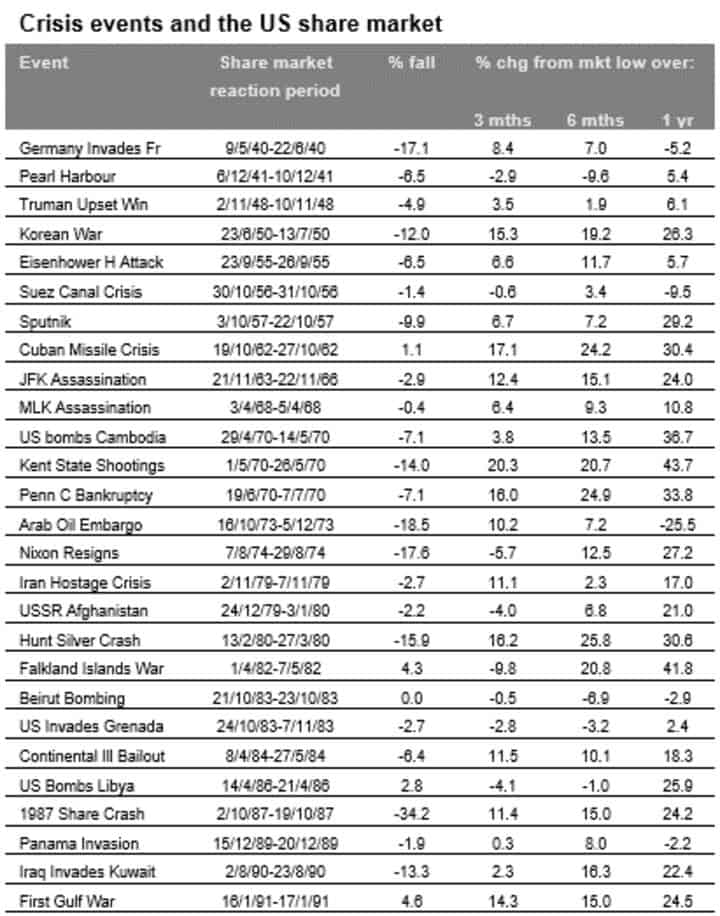
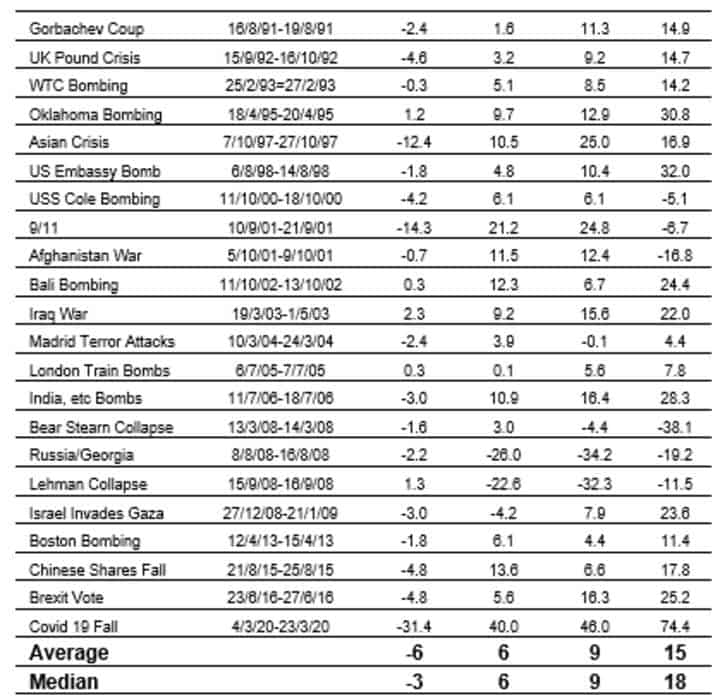
Based on the Dow Jones Index. Intended as a guide only as other developments also impact shares around the dates shown. Source: Ned Davis Research

The pattern is pretty much the same for most events, with an initial sharp fall in the share market followed by a rebound. Since World War Two the average decline has been 6%, but six months later the share market is up 9% on average and 1 year later its up around 15%.


What does it all mean for investors?

I don’t have a perfect crystal ball and its even hazier when it comes to events around wars. But from the point of sensible long-term investing, the following points are always worth bearing in mind in times of investment markets uncertainty like the present:

  • Periodic sharp falls in share markets are healthy and normal, but with the long-term rising trend ultimately resuming and shares providing higher long term returns than other more stable assets.
  • Selling shares or switching to a more conservative investment strategy after a major fall just locks in a loss and trying to time the rebound is very hard such that many only get back in after the market has recovered.
  • When shares fall, they are cheaper and offer higher long-term return prospects. So, the key is to look for opportunities the pullback provides. It’s impossible to time the bottom but one way to do it is to average in over time.
  • While shares have fallen, dividends from the market haven’t. Companies like to smooth their dividends over time – they never go up as much as earnings in the good times and so rarely fall as much in the bad times. And in the meantime, the income the dividends provide is still being received.
  • Shares and other related assets bottom at the point of maximum bearishness, ie, just when you feel most negative towards them.
  • The best way to stick to an appropriate long-term investment strategy, let alone see the opportunities that are thrown up in rough times, is to turn down the noise around the news and opinion flow that is now bombarding us.


Super opportunities you don’t want to miss

mark · Feb 16, 2022 ·

The Bill implementing the majority of the super changes proposed in the 2021-22 Federal Budget has passed both houses of Parliament and awaits royal assent.

The Bill contains the following measures from 1 July 2022:

  • changes to work test conditions
  • extension of non-concessional bring-forward rule for people aged 67 to 74
  • reduced eligibility age for downsizer contributions from age 65 to 60
  • removal of $450 per month threshold for super guarantee


Remove work test requirement

Currently, a member aged 67 to 74 must satisfy a work test (or qualify for a work test exemption) to make voluntary super contributions (excluding downsizer contributions).

The Government proposed, in the May 2021 Federal Budget, removing the work test (or work test exemption) requirement for non-concessional contributions and salary sacrifice contributions from 1 July 2022.

This means that members no longer need to meet the ‘work test’ to be able to contribute to super in after-tax dollars (and salary sacrifice), up until age 74.

However, from 1 July 2022, the work test (or work test exemption) will still apply to personal tax-deductible contributions where a member is aged 67 to 74.


Extend NCC bring forward rule to clients under age 75

Currently, a member must be under age 67 at the start of a financial year in order to trigger the non-concessional contributions cap bring-forward rule in that year.

From 1 July 2022, the maximum age for the bring-forward rule will increase so that a member can trigger the bring-forward rule in a financial year where they are under age 75 at the start of the year.

This means that up to $330,000 can be contributed to super in after-tax dollars in one financial year and/or over a three year period – up until age 75.


Reduce minimum age to make a downsizer super contribution to 60

From 1 July 2022, the minimum age to make a downsizer contribution (measured at the time of contribution) will reduce from 65 to 60. This will allow some members aged 60 to 64 to potentially contribute $630,000 (or $1.26 million combined in the case of a couple) at one time to super by combining a downsizer contribution with the three year non-concessional contributions bring-forward rule.


Remove SG $450 income threshold

Currently, where an employee earns less than $450 in a calendar month, their employer is not required to pay superannuation guarantee (SG) on those earnings.

For SG quarters commencing 1 July 2022, this minimum SG threshold will be abolished and an employer will be required to pay SG on earnings less than $450 in a calendar month.

Source: Colonial First State, FirstTech Newsflash, 11 February 2022

Could a Sabbatical Increase Your ROL (Return On Life)?

mark · Feb 14, 2022 ·

The personal and professional displacement we all experienced during the pandemic has inspired many people to reassess what work means to them. Rather than let these questions linger, it could be productive to approach them with a more formal plan of action, introspection, and recalibration.

If your employer offers sabbatical benefits, now might be the time to use them. And if not, adopting a “sabbatical mindset” could help you to improve the Return on Life you’re getting from work. Your employer might even offer alternative benefits that help you explore without leaving your job.

Here are four ideas for a productive sabbatical that are adaptable to most working situations.

Keep learning.

Many companies have started offering continuing education programs to their employees. Talk to your HR department about what kinds of classes are covered and what kinds of skills you could develop to benefit both you and your current employer.

If you’re thinking about becoming a full-time student again, it’s still important that you focus on specific skills and professional goals. With those aims in mind, you can start exploring the wealth of adult education options available to you, whether that means in-person classes or virtual learning that will let you earn a degree or certification on your schedule. Working seniors might also be eligible for heavily discounted tuition at community colleges and local universities.

Volunteer.

Allowing for volunteer work during regular working hours is another corporate benefit that’s growing in popularity. Whether you’re supporting your employer’s greater mission or carving a few hours out for your own causes, giving back can open your eyes to the needs in your community and the wider world. If you want to go all-in, you might take a part-time position at a charitable organization or non-profit or join a work and travel program that immerses you in the lives of the people you’re helping. That perspective could shape the kind of work you want to do going forward, including a potential career change.

Start hustling.

Have you ever dreamed of being your own boss? Use a sabbatical to water that business idea you’ve never had time to focus on exclusively. Perhaps you could burnish your business plan by combining side-hustle time with some continuing education that will improve your CEO skills as well. You could also spend your sabbatical doing small trials of your goods and services or mastering the SEO skills you’ll need to zero in on your ideal customer base.

Reconnect your mind and your body.

Once you’ve unplugged from your traditional 9-to-5, you might feel compelled to completely revamp your daily routine. Consider making more time for exercise and mindfulness. Try a new sport or fitness activity. Take morning walks with your spouse. Spend a few minutes at the beginning and end of the day praying, reflecting, or keeping a gratitude journal. Or just block off  fifteen minutes in the afternoon for a cup of coffee, a good book, and an inspiring view.

Upgrading your routine might not seem essential to answering the professional questions that led you to your sabbatical. But whether you return to your old job or start working towards a new career, self-care will be essential to avoiding more burnout and maintaining your sense of purpose. Once you’ve found a routine that energizes your mind and your body, you’ll be able to structure other essential tasks around it, which can lead to higher productivity and a greater sense of fulfilment.

Are you considering a sabbatical or a career change? Are you concerned about how that change could affect your financial goals? Let’s talk about how Cornerstone Wealth’s Life-Centred Planning process can help you chart the best path forward.

What’s Your Debt Story and How Do You Feel About It?

mark · Apr 16, 2021 ·

In a recent study, half of Americans said their expenses are equal to or greater than their income (1). The statistics for Australians are likely to be quite similar. Revolving credit, particularly credit cards, is an increasingly significant part of the equation.

The phrase “credit card debt” usually triggers red flags when we’re talking about long-term financial planning. And in fact, the average US household now carries $15,654 on their cards, and pays $904 annually in interest (2).

But debt, in and of itself, isn’t good or bad.

Instead of making a value judgement about how you use debt, when working with clients we like to understand:

  • What is your debt story?
  • What are your attitudes about debt?
  • Why do you feel the way you do?
  • How are your debt levels affecting the “Return on Life” your money provides?

Having a deeper understanding of the above helps us do a better job positioning your money to work more effectively for you.

What’s the big picture?

Our current high debt levels reflect a previous generation of low interest rates, an active housing market, a robust credit market, and relative peace and prosperity. This meant more consumers with more plastic and more loans.

Again, debt is not bad in and of itself, especially in a healthy economy. But from 2007-2009, many highly-leveraged people and companies were vulnerable to foreclosure and bankruptcy during the Global Financial Crisis.

People who were born between the Great Depression and World War II grew up in the daily realities of war and lean markets. Unsurprisingly, this group tends to avoid using credit cards when they can. Instead, they rely on the cash in their hands and the cheque-books they balance with pen and paper.

That credit-aversion seems to have skipped the Boomer generation, who, generally speaking, happily used credit cards and home-equity loans.

The current generation of young workers—Millennials—seem to be warier about carrying debt than their parents were.

Young people are entering the workforce at a time when household income is struggling to keep pace with the cost of living. They believe taking on debt would only widen that gap. In particular, the costs of medical care, housing, and food continue to grow faster than income (2).

Many underemployed Millennials are living at home into their late-20s, so they aren’t using credit cards to finance luxury items or buy first homes. Even for millennials who do find good jobs after university, many start their adult lives in the red because of student loans.

Millennials are less enthusiastic about investing in the markets. Growing up during the Great Recession shook their faith in the economy. Growing up in the shadow of 9/11 and terrorism, they’ve only known a world unsettled by global unrest.

Millennials are also a more conscientious consumer group than their parents were. They want to spend their time, and their money, on things that help to make the world a better place. They consider personal fiscal responsibility to be part of a greater good.

What’s your story?

While looking at big picture debt trends is useful for predicting where the economy is headed, your Life-Centred Plan is about you. Now would be a great time to take a minute to consider:

  • How do you feel about debt?
  • Why do you think that you feel the way you do?
  • Are you comfortable with your current level of debt?
  • Is your current level of debt causing any problems with one of your loved ones?
  • Do you pay off your credit card balances in full every month?
  • How do your attitudes about debt align or differ with those of your parents? Why do you think that is?

We encourage you to reach out to us and we can take a closer look at your financial situation and help you get on a more comfortable path. Together, we can create a financial plan that will improve your “Return on Life”.

Sources:
1. Half of Americans are spending their entire pay-cheque (or more) http://money.cnn.com/2017/06/27/pf/expenses/index.html
2. Nerdwallet’s 2017 American Household Credit Card Debt Study https://www.nerdwallet.com/blog/average-credit-card-debt-household/

  • « Go to Previous Page
  • Page 1
  • Page 2
  • Page 3
  • Important information

Cornerstone Wealth Solutions Pty Ltd
ABN 57644823218
AFSL 537488

Information on this site may be regarded as general advice. That is, your personal objectives, needs or financial situations were not taken into account when preparing this information. Accordingly, you should consider the appropriateness of any general advice we have given you, having regard to your own objectives, financial situation and needs before acting on it. Where the information relates to a particular financial product, you should obtain and consider the relevant product disclosure statement before making any decision to purchase that financial product.

This website uses cookies to improve your experience. We'll assume you're ok with this, but you can opt-out if you wish. Cookie settingsAccept
Privacy & Cookies Policy

Privacy Overview

This website uses cookies to improve your experience while you navigate through the website. Out of these cookies, the cookies that are categorized as necessary are stored on your browser as they are as essential for the working of basic functionalities of the website. We also use third-party cookies that help us analyze and understand how you use this website. These cookies will be stored in your browser only with your consent. You also have the option to opt-out of these cookies. But opting out of some of these cookies may have an effect on your browsing experience.
Necessary
Always Enabled
Necessary cookies are absolutely essential for the website to function properly. This category only includes cookies that ensures basic functionalities and security features of the website. These cookies do not store any personal information.
SAVE & ACCEPT